Managing a post-merger integration is a mammoth task. Integrating everything is not a requirement.
Objectives should be challenging – no doubt. The objective to integrate an acquired business in full may be a little too much, though: Full integration is rarely required to achieve the major acquisition goals, and is usually only asked for if a clear business strategy has not been formulated.
A full integration approach is less targeted than a focused strategy, and often leads to a scenario in which everybody integrates something, but nobody understands the true integration objective and benefit. A lack of prioritization of integration goals will inevitably lead to resource issues, and resource issues lead to frustration. A thought-through change concept does not exist. Consequently, the organization will be very busy, but likely also another example for an unsuccessful integration attempt.
Prevention strategies include:
Management involvement in developing the future organization design
Developing a target operating model (a.k.a. „TOM“ – compare this article)
Leadership commitment to the TOM
Identification and elimination of leadership that will not be part of the joint business
ROI hinges on investment amount, future income flow, and time. The latter tends to get ignored.
More often than not, I get called to support a project that is past due already. At the time I arrive on site, management has realized that the original timeline cannot be met, and that integration progress and synergy delivery are delayed. In other words: The original timeline is shot, with the knock-on effect that the entire financial model does not work anymore.
Mostly, a lack of planning during due diligence can be identified as the root cause: The effort linked to integration is larger than anticipated, there is no structured project management or controlling, risks and progress (or the lack thereof) are not clearly communicated. In addition, frequently day-to-day business and integration work are not properly aligned, leading to competing priorities.
There are, however, a few things management can do to avoid this scenario:
Start integration planning with due diligence (or even earlier)
Implement a strict project governance
Assign strong managers to the project team
Communicate, discuss and review priorities
Develop transparent project KPIs (financial and non-financial)
A post-merger integration represents an enormous effort. Many businesses underestimate the resource drain.
Deal preparation is important, however, the true integration effort starts after signing. As a matter of fact, even if you have an in-house M&A team, most of the work lies with functional management and their teams. I have seen very few organizations – actually close to zero – who would have an additional layer of resource available for the occasional integration work.
That is one reason that integration teams are frequently staffed with people unqualified for the job – their only merits were that they were available at the time…. In addition, day-to-day business takes priority in may cases, leading to a distraction of management and their operational employees. If teams get overloaded, frustration builds, people resist change and eventually they may even leave.
Prevention strategies include:
Assess resources before signing
Bring in M&A experienced resource
Align management and set realistic expectations
Consider changing the reward system to achieve integration goals
Create a positive atmosphere for change and creativity
“Don’t worry – benefits are coming.” Well – sometimes they don’t.
Overestimation of synergies is one of the reasons for unsuccessful M&A projects. If all and any – even remotely possible – synergy effects are included in the financial M&A model, any shortcoming will have an unrecoverable negative impact on ROI.
M&A Managers and C-Level Executives should consider risk adequately in their models. Amongst other, risks may emerge due to timing, market or lifestyle developments, competitor reaction, or innovation/substitution. When pulling the model together, a couple of prevention strategies can be applied to avoid stepping into the “We’ll be fine!”-M&A pitfall:
Calculate major contributing synergies, and apply a decent risk factor
At times, the result stands before the analysis has even started (photo by Breakingpic on Pexels)
At times, people know the outcome of the analysis before the analysts have started the evaluation process, or even completed their model. They want a certain result – a result in line with their personal preference.
In the context of M&A, such expectation to hit a certain mark can lead to grave consequences, yet still it is not unheard of. Evaluation methods use parameters, and parameters can be changed – sometimes they get adjusted, tweaked and changed until the arithmetical result fits the bill. The downside obviously is that the parameters may not be reflective of reality, risks are being ignored, and sensitivities are left unconsidered in the decision process.
Therefore, an independent check of the model and the applied assumptions is helpful. Other prevention strategies include:
Do not change assumptions without substantial reasoning.
Apply the 80/20 rule: Calculate the most important synergies only, and ignore the rest.
Be sure to have the resource to implement any planned initiatives, in terms of manpower, competence and funding.
No Deal – No Gain: Some M&A deal parties would rather close a deal than not, only for their own monetary interest (photo by Pixabay on Pexels)
In preparing a M&A deal, certain groups or individuals may want to see the deal through no matter what.
Banks, consultants and advisors: They all take their share of the deal, and have a legitimate interest to make their piece of the cake as large as possible. However, if a deal falls through, they may still write a few bills, but the lion’s share of the gain is gone; their resource investment is largely in vain.
Other stakeholders may fear that they will lose face or credibility if their proposal to acquire a certain business was rejected. Yet others may view an acquisition as their very own and personal undertaking, and will not support a decision that would mean a stop to their pet project.
The truth of the matter is that rejection of a potential investment due to failed target criteria conformity is a sign of strength, rather than of weakness. Strong leaders and managers stand out in adverse conditions and rather take a moment of heat than carry the long-lasting consequences of a failed project.
A common strategy to prevent the „Just get it done!“ M&A pitfall entails the upfront agreement of certain rules in deal sourcing and preparation, for example:
Monitor more than one potential M&A target
Discuss the possibility of saying “no” prior to due diligence, and be ready to say it if needed
Because M&A is people business, informing and involving people concerned with the program is very important. As opposed to many other workstreams, Communications need to be at the ready on Day 1: People will want to know what is going on immediately with the announcement of the acquisition or merger, not later.
Early employee information should center around
the meaning and external impact of the project,
what is driving the value to customers behind the transaction,
what is expected from the employees,
how and when the implementation of the vision will take place.
While Day 1 communication is a first-level leadership task, ongoing communication can be, and should be, spread out through different organizational levels.
To a normal employee, change is worrying. That’s the reason that common questions target the change aspects of the program. Employees are very little concerned with what the acquisition means to the company and to financial earnings. They worry about the meaning of the transaction to them, personally and professionally. Ongoing communication should address these questions respectfully, and openly. Difficult discussions must not be avoided.
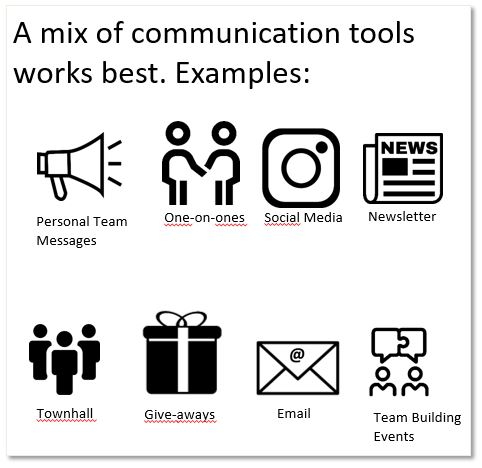
HR may function as the communication center and catalyst, but communication must not be an exclusive HR task. Deployment of various communication tools in parallel has proven to be most effective.
Follow nine rules of post-merger integration to increase the odds for a successful project (Photo by Magda Ehlers on Pexels)
Over the past weeks, I have written nine short pieces on select PMI-related subjects. Each of the articles featured a rule (or a recommendation) which should be generally followed in standard PMI programs. There are no guarantees, but heeding them will increase the probability of a successful, value-adding and satisfying PMI process.
These are my suggestions helping you shape up your acquisition and post-merger integration program (each linked to the respective article):
Much of the above sounds like common sense, and in most cases, it is. However, many failed integration attempts illustrate that a post-merger integration process is not as simple as it sounds. In fact, PMI is a very complex endeavor, involving people, behaviors, (competing) targets, different processes and systems. I have certainly not discussed all and every aspect of an integration project a PMI manager should consider. PMI takes planning, preparation and targeted execution. It binds resources and distracts from the day-to-day business. Yet, growth by acquisition is a proven means to outperforming competition and industry peers. A failed integration though is costly and can bring down an entire company, alongside its management. Therefore, I recommend not only your acquisition process be guided by knowledgeable external advisors, but in doubt the integration process, too.
Christopher Kummer, president of the Institute of Mergers, Acquisitions and Alliances, a research organization in Zurich, Switzerland, said once “Nothing compares to what comes after you acquire the business.” I think he is right.
Diethard Engel Management & Consulting Services
Based out of Germany, Diethard Engel is an independent consultant and interim manager, focused on Business Transformation, Post-merger Integration / Carve-out and Executive Finance. He has run multiple post-merger integration/carve-out projects for international businesses.
In part 7 of my series on PMI, I have discussed common integration sequencing, namely integrating straight-forward backoffice functions like Finance & Accounting first, followed by core functions, for example Sales & Marketing. IT seems to fall through the cracks. It shouldn’t.
IT Integration is complex and risky, but necessary nonetheless. (photo by Brett Sayles on Pexels)
First things first: If an IT business acquires another IT business, obviously IT is anything but infrastructure: It is the very core function. In the PMI scenarios I am looking at, IT is merely an enabler: It’s the backbone of any standard industrial manufacturing business, and also for most service providers, for banking and insurance firms. Without IT, there are no business systems, there is no ERP, no management of complex projects, and no communication, neither by email nor by phone. IT for many businesses is vital. Touching IT systems, switching platforms, or even releases, can be a very demanding project, in terms of risk, resources human and financial, while the immediate reward seems limited. Still, there is a reward, and a common IT platform may not fuel growth in the long run, but at least a fragmented IT environment does not limit growth either.
So, where to begin? I recommend going to back to the TOM (Target Operating Model) – or, as I like to call it: The Holy Grail of integration. The TOM dictates integration targets and sequence. If any of these targets are linked to specific IT systems, the acquirer will know which ones need changing, upgrading, or integrating. The focus should be on those systems only which support delivery of the TOM, and hence enable delivery of the strategy.
Rule #9: Integrate IT systems linked to implementation of the TOM only.
Standardizing any other systems in future still has its merits, but there is no immediate need to act. Rather than making non-strategic IT systems a part of the post-merger integration program, they should be tackled for renewal and harmonization in context of their standard product life cycle.
However, in course of the PMI process a couple of IT-related steps should be taken in any case: The new IT strategy should reflect the new combined companies’ strategy. Future requirements on IT systems will also determine what kind of workforce will be needed. A combined IT organization may require less or differently qualified staff. In addition, contracts and license agreements should be checked, and the server and service environment reviewed for harmonization and saving potential.
This is the last article in my column on post-merger integration. Thank you for visiting an reading.
Diethard Engel is an independent consultant and interim manager, focused on Business Transformation, Post-merger Integration / Carve-out and Executive Finance. He has run multiple post-merger integration/carve-out projects for international businesses.
Understanding corporate culture is difficult – that’s why it’s ignored in many post-merger integrations. It does not have to be like this.
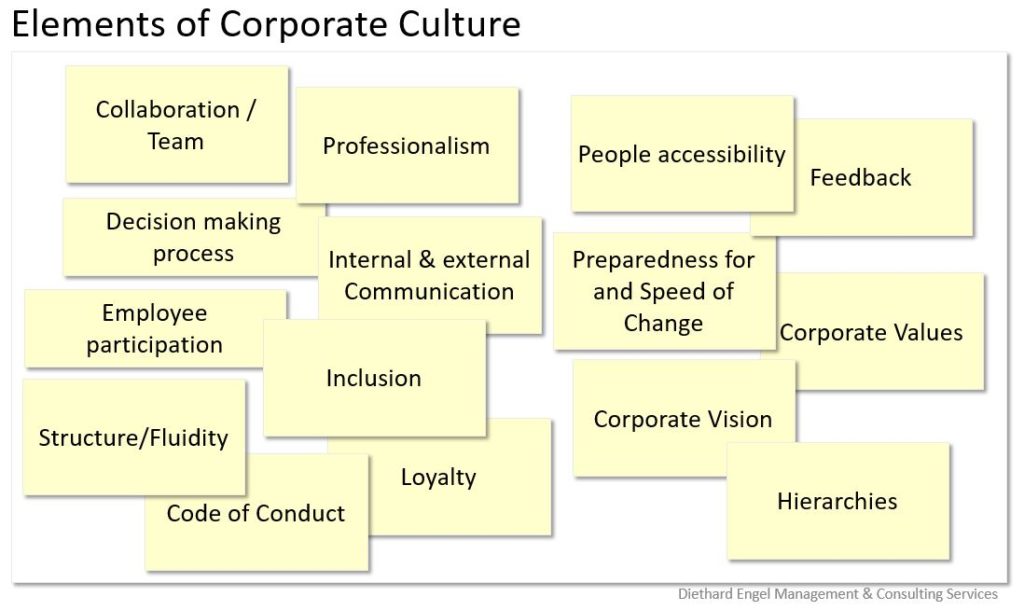
Cultural integration has proven to be a key success factor in merger execution: Most acquirers claiming a successful integration say they have considered cultural aspects in the PMI process. In order to be able to address culture, obviously one got to understand what “culture” means, first. In short, corporate culture is the sum of all elements impacting on people or organizational behavior.
Corporate Culture is a multi-dimensional complex.
Culture is qualitative by nature, and therefore difficult to measure, however, that does not mean it wouldn’t be measurable: Rankings or ratings are frequently used to gauge non-quantitative parameters. Identification of those elements meaningful to a specific target culture is key to a successful integration: Symbols, stories and rituals on one hand, and specific behaviors and processes on the other dictate how people feel and act.
Corporate culture is directly reflected in leadership behavior. Therefore, change to culture requires change to leadership behavior, which leads to my
Rule #8: Cultural change often transpires to change to leadership.
Acquirers should know who will lead in future, and whether the designated leadership will live the desired culture. Walk the talk is more than just a proverb: It is what employees see, and eventually imitate. Depending on the scale of cultural gaps, bringing in outside leadership may be an option worth considering.
The degree of formality in a business may determine the amount of leadership change an organization can endure: Knowhow and personal relationships are assets an acquirer has paid a price for. However, the less formal an organization, the more it relies on leadership and continuity. This may limit the ability to stipulate cultural change through leadership team changes.
Trying to change an entire business culture may overwhelm the organization. Rather think about a few elements that are key to the success of the new (joint) business, and target these for change. As a result, the team will focus on managing meaningful differences, and not take away cultural elements which are not critical to business performance, but important to people and their microcosm.
Diethard Engel is an independent consultant and interim manager, focused on Business Transformation, Post-merger Integration / Carve-out and Executive Finance. He has run multiple post-merger integration/carve-out projects for international businesses.